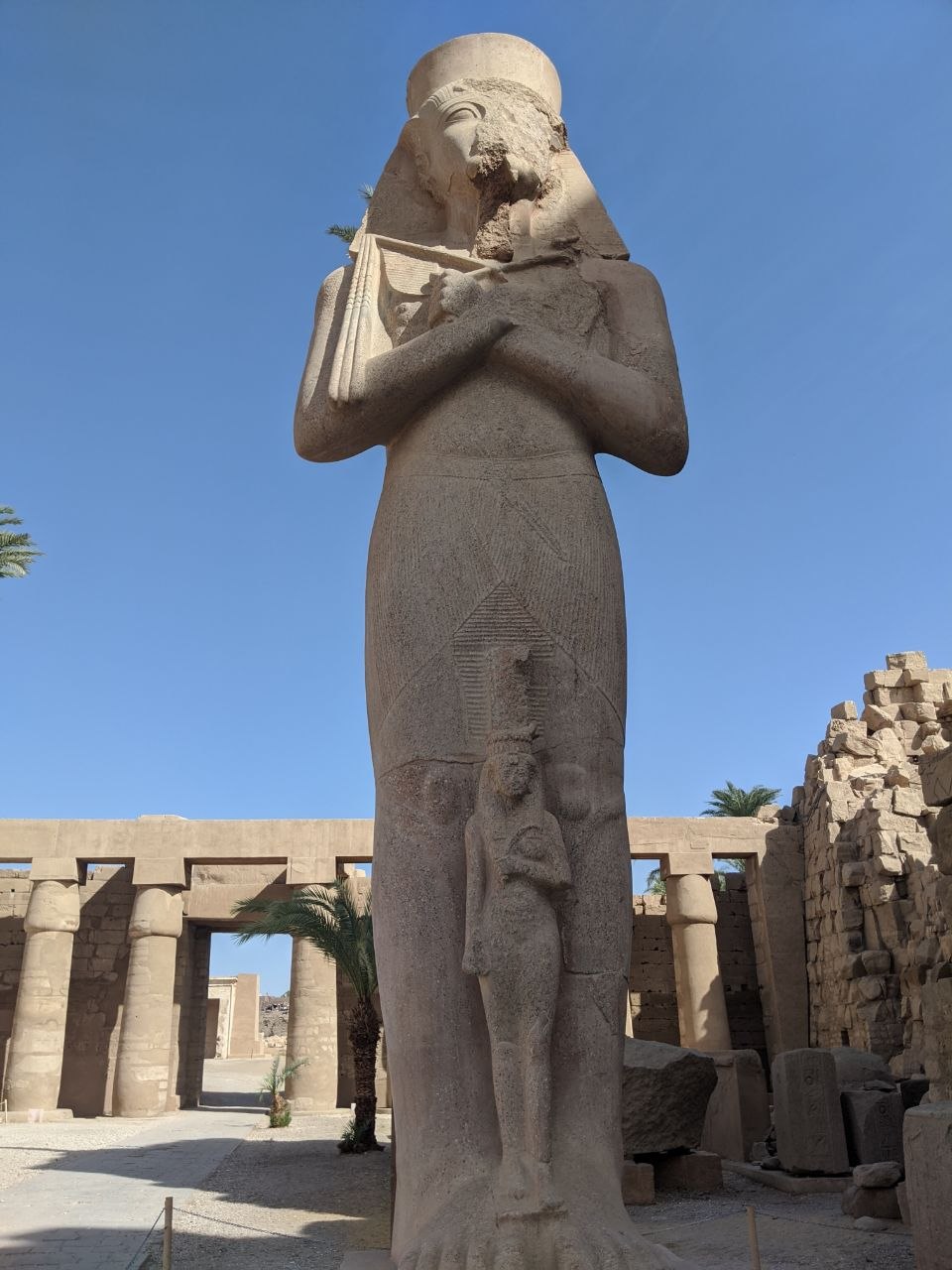
Karnak, on the east bank of the Nile at Luxor, is the largest ancient religious complex ever built. Constructed over a period of approximately 2,000 years — from the Middle Kingdom through the Ptolemaic period — it served as the primary cult centre of Amun-Ra, the king of the gods and the state deity of Egypt during the New Kingdom. At its height, Karnak encompassed multiple temple precincts, administrative buildings, workshops, priests’ quarters, and sacred lakes covering an area of over 100 hectares. The scale of individual structures within the complex — its pylons, hypostyle halls, obelisks, and colonnades — remains without parallel in the ancient world. More than thirty pharaohs contributed to its construction over the centuries, each adding, enlarging, or embellishing existing structures in a continuous accumulation of monuments that reflects the full sweep of ancient Egyptian history.
The Avenue of Sphinxes
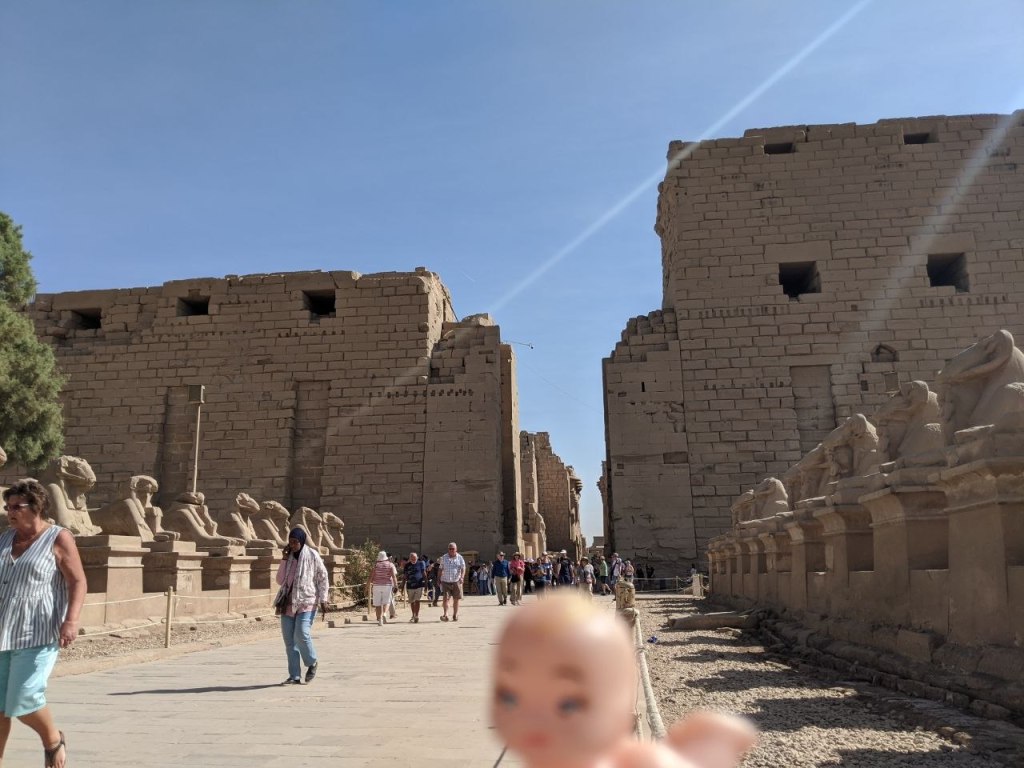
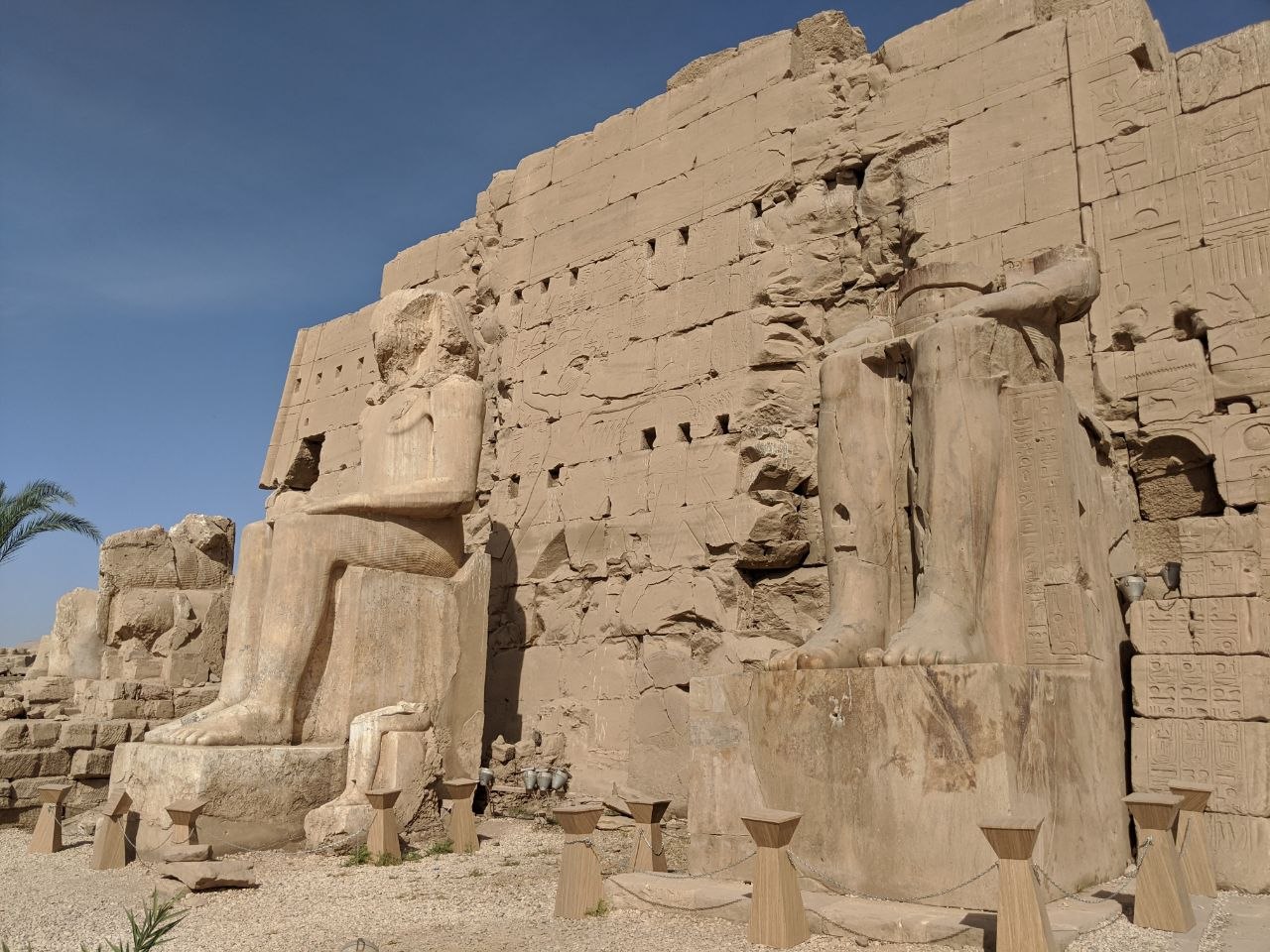
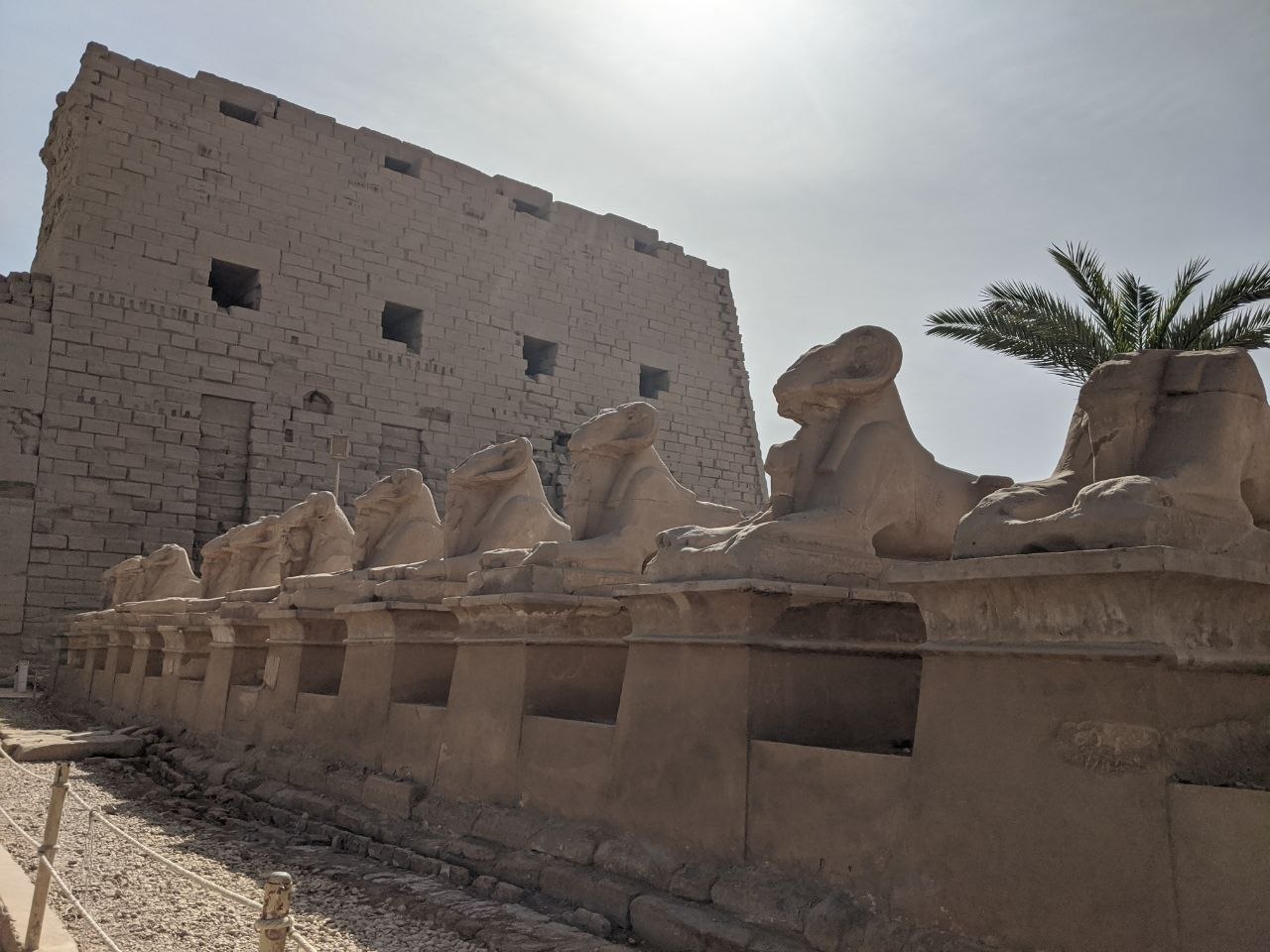
The main approach to the Precinct of Amun-Ra is through the Avenue of Sphinxes — a processional road flanked on both sides by a continuous row of ram-headed sphinxes, each couchant on a low rectangular plinth and sheltering a small statue of the pharaoh Ramesses II between its forelegs. The ram is the sacred animal of Amun, and the avenue served as the ceremonial route for the great religious festivals — most importantly the Opet Festival, during which the sacred barque of Amun was carried from Karnak to Luxor Temple in an annual procession of priests, musicians, and celebrants. The avenue originally extended the full 3 kilometres between Karnak and Luxor Temple; sphinxes along its entire length were restored and the full route reopened in 2021. The first pylon — the main gateway of the Amun precinct, the tallest of Karnak’s ten pylons at 43 metres — rises directly at the end of the avenue, its massive trapezoidal towers of rough sandstone still showing the remains of mudbrick construction ramps used during its construction in the Late Period.
The Great Hypostyle Hall
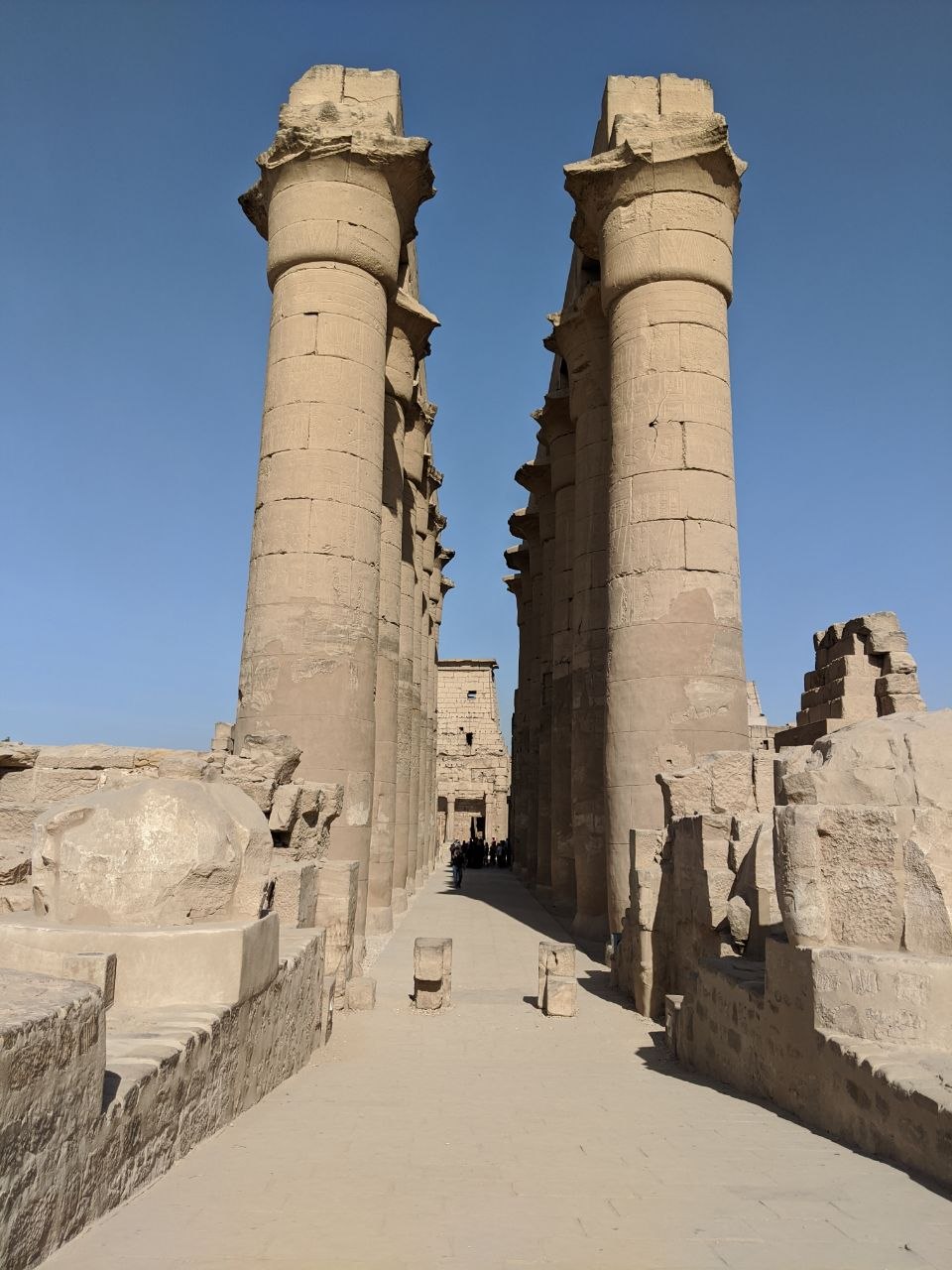
Beyond the first pylon lies the Great Court, and beyond that the most celebrated space in the entire complex: the Great Hypostyle Hall, constructed primarily during the reigns of Seti I and Ramesses II in the 19th Dynasty. Covering an area of approximately 5,000 square metres, the hall contains 134 massive sandstone columns arranged in 16 rows. The central nave is formed by two rows of 12 columns standing 21 metres tall with open papyrus-capital tops — their diameter so great that 100 people can stand on the surface of a single capital. The flanking aisles are formed by 122 shorter columns with closed bud capitals, their tops 13 metres above the floor. Every surface of every column, wall, and architrave — inside and out — is covered in carved and painted relief: scenes of royal ritual, battle, offering, and divine encounter, with hieroglyphic texts identifying each figure and scene. The reliefs on the north side of the hall were carved under Seti I and retain much of their original paint; those on the south side were completed under Ramesses II and are incised rather than raised relief. The scale of the space — 102 metres wide, 53 metres deep — makes it one of the most physically overwhelming interior spaces created in the ancient world.
Obelisks & the Sanctuary of Amun
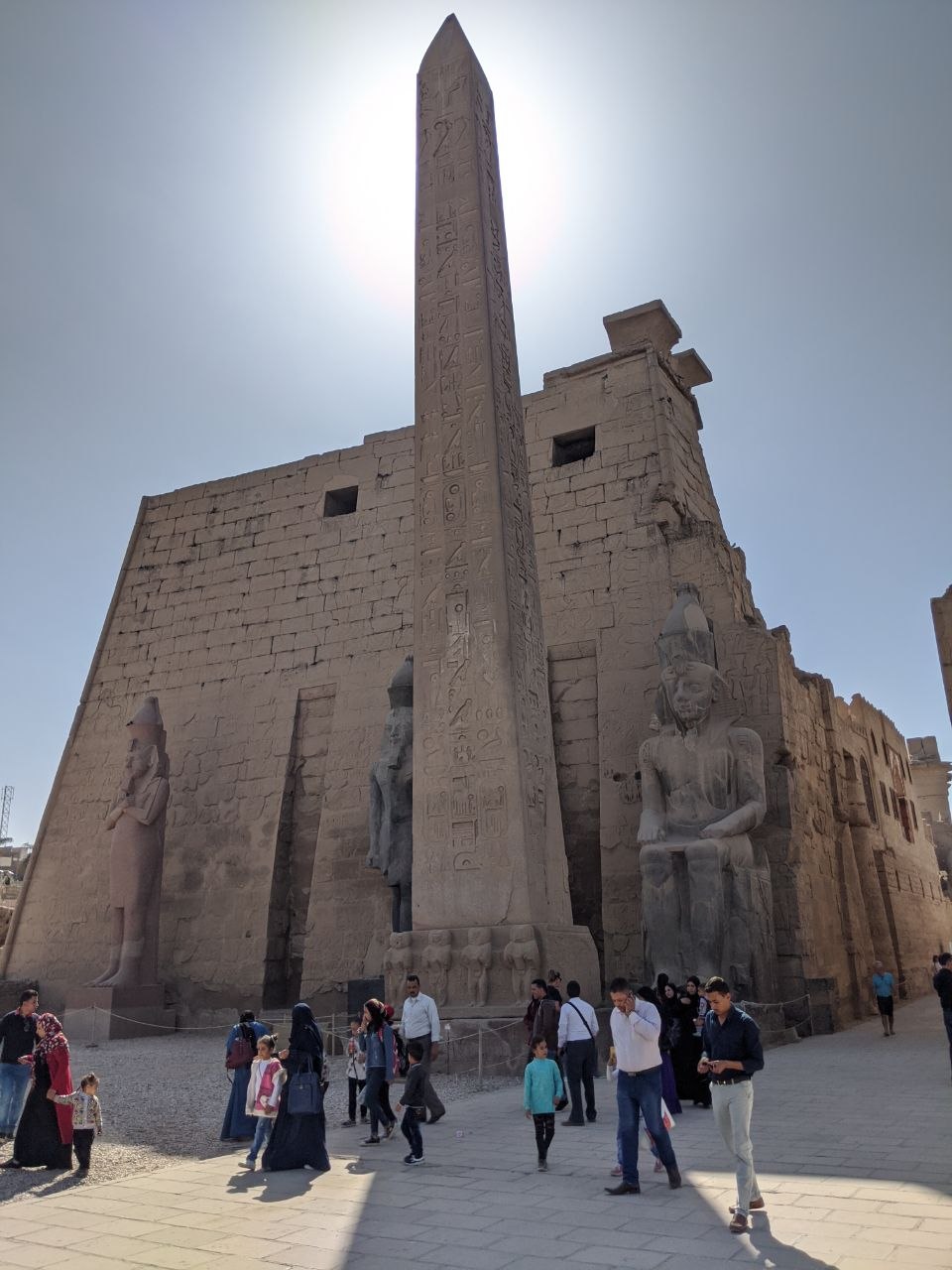
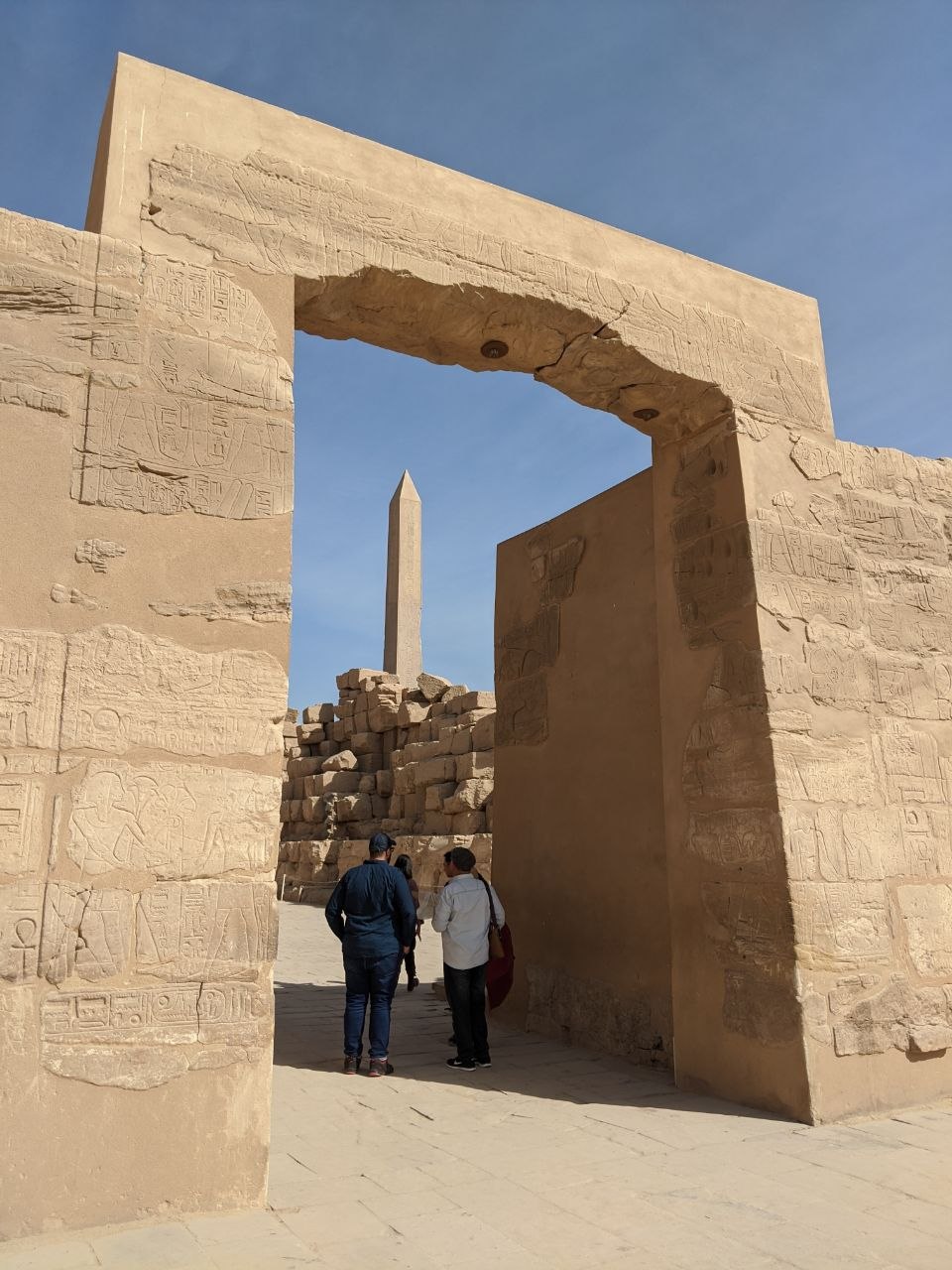
Within the inner precincts of Karnak stand several of the great obelisks erected by New Kingdom pharaohs as acts of devotion to Amun-Ra. The most prominent surviving example is the obelisk of Hatshepsut — one of a pair she erected in the Festival Hall of Thutmose I — which at 29.5 metres remains the tallest standing obelisk in Egypt. Its partner now stands in the Lateran Square in Rome. The surface of Hatshepsut’s obelisk is carved with inscriptions recording her reign and piety, and was originally tipped with electrum — an alloy of gold and silver — designed to catch and reflect the first rays of the rising sun. At the heart of the complex, beyond the succession of pylons and courts, lies the original sanctuary of Amun: a small, dark granite shrine where the golden cult statue of the god was housed and tended daily by the high priests of Amun. The sanctuary is surrounded by the remains of earlier structures going back to the Middle Kingdom, their walls preserving some of the oldest religious texts and images in the entire complex.
The Sacred Lake
To the south of the main temple axis lies the Sacred Lake of Karnak — a large rectangular reservoir measuring approximately 120 by 77 metres, cut from the desert and lined with sandstone quays. The lake was used for ritual purification by the temple priests, who were required to bathe in its waters before performing religious ceremonies, and for the nocturnal procession of the sacred barques of Amun, Mut, and Khonsu during festival celebrations. Geese sacred to Amun were kept on its banks. The lake is flanked on its north side by a large stone scarab dedicated by Amenhotep III — one of the most-photographed objects at Karnak, and the subject of a tradition that walking around it seven times will bring good luck. A viewing platform at the lake’s edge provides the classic panoramic view back across the water toward the obelisk of Hatshepsut and the hypostyle hall roofline beyond.
Visiting Tips
Karnak is located approximately 3 kilometres north of central Luxor on the east bank of the Nile and is easily reached by taxi, calèche, or a pleasant walk along the Corniche. The site is large — a full visit covering the main Amun precinct, the hypostyle hall, the inner sanctuaries, and the Sacred Lake takes at least two to three hours — and comfortable footwear is essential on the uneven stone surfaces. Early morning opening (the site opens at 6 AM) offers the best light for photography and the coolest temperatures before the main tourist rush. A sound-and-light show is held at the temple on most evenings, running in multiple languages, and provides a different perspective on the complex after dark. Karnak is typically combined with a visit to Luxor Temple — located at the other end of the Avenue of Sphinxes in the town centre — as part of a full east bank day.
 Jumping Timezones
Leave a comment