Seville (Sevilla) is the capital of Andalusia and the fourth-largest city in Spain, situated on the banks of the Guadalquivir River in the southwest of the Iberian Peninsula. With a metropolitan population of around 1.5 million, it is one of the most historically significant cities in the country — the gateway through which the wealth of the Americas flowed into Spain during the 16th and 17th centuries, and the city that gave the world flamenco, tapas culture, and some of the most celebrated architecture on the continent. Seville’s historic centre contains three UNESCO World Heritage Sites within a single urban complex: the Cathedral, the Giralda tower, and the Real Alcázar. The city is also known for its intense summer heat — temperatures regularly exceed 40°C in July and August — and for Semana Santa (Holy Week) and the Feria de Abril, two of the most spectacular popular festivals in Europe.
The Real Alcázar
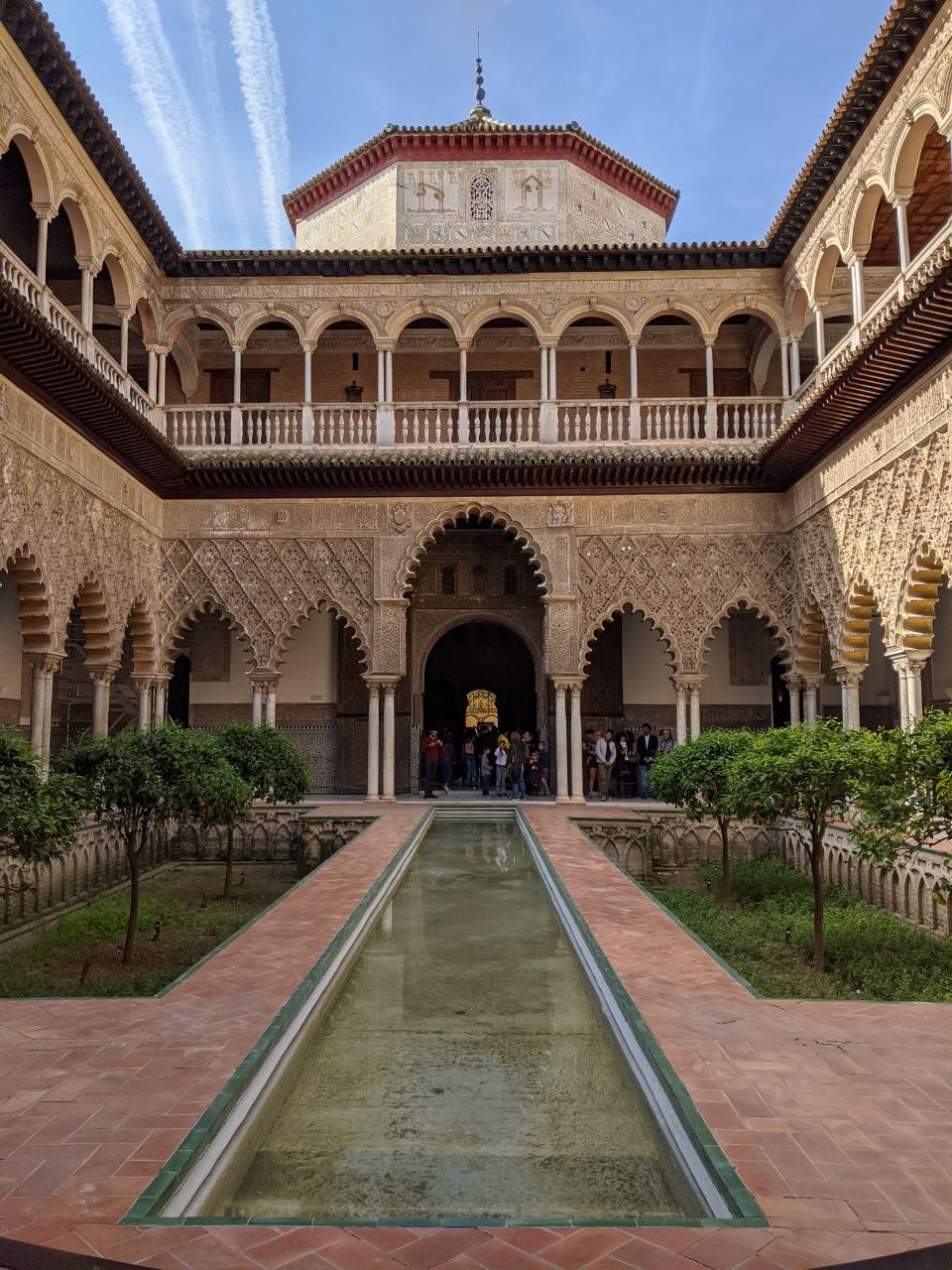
The Real Alcázar of Seville is a royal palace complex of extraordinary architectural richness, continuously occupied by the Spanish royal family — making it the oldest royal palace still in official use in Europe. Its origins are Moorish, with the earliest documented structures dating to the 10th century, but the palace as it exists today was largely built by the Christian king Peter I of Castile beginning in 1364, in the Mudéjar style — a synthesis of Islamic and Christian architectural traditions unique to the Iberian Peninsula. The centrepiece of the complex is the Patio de las Doncellas (Court of the Maidens): a long rectangular reflecting pool set within an arcaded courtyard whose walls are covered in elaborate carved stucco geometric ornament, multifoil horseshoe arches, and blue-and-white azulejo tile dados. Upper galleries of Renaissance arches added in the 16th century rise above the Mudéjar ground floor, creating a layering of styles that reflects the long history of the palace’s construction. The Alcázar’s gardens extend behind the palace buildings — a sequence of walled enclosures, fountains, and orange trees that provide shade in the Sevillian heat.
The Cathedral and the Giralda
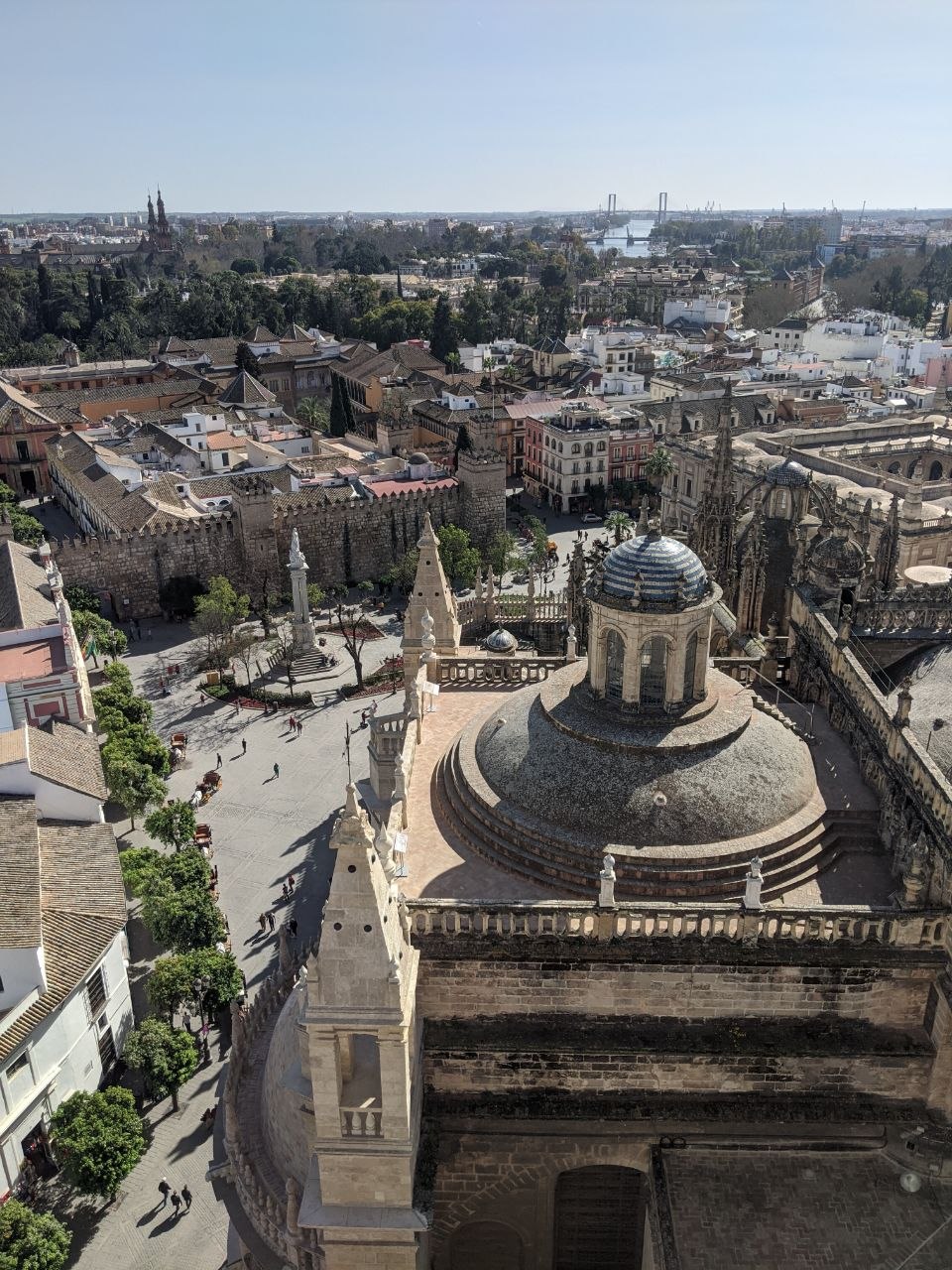
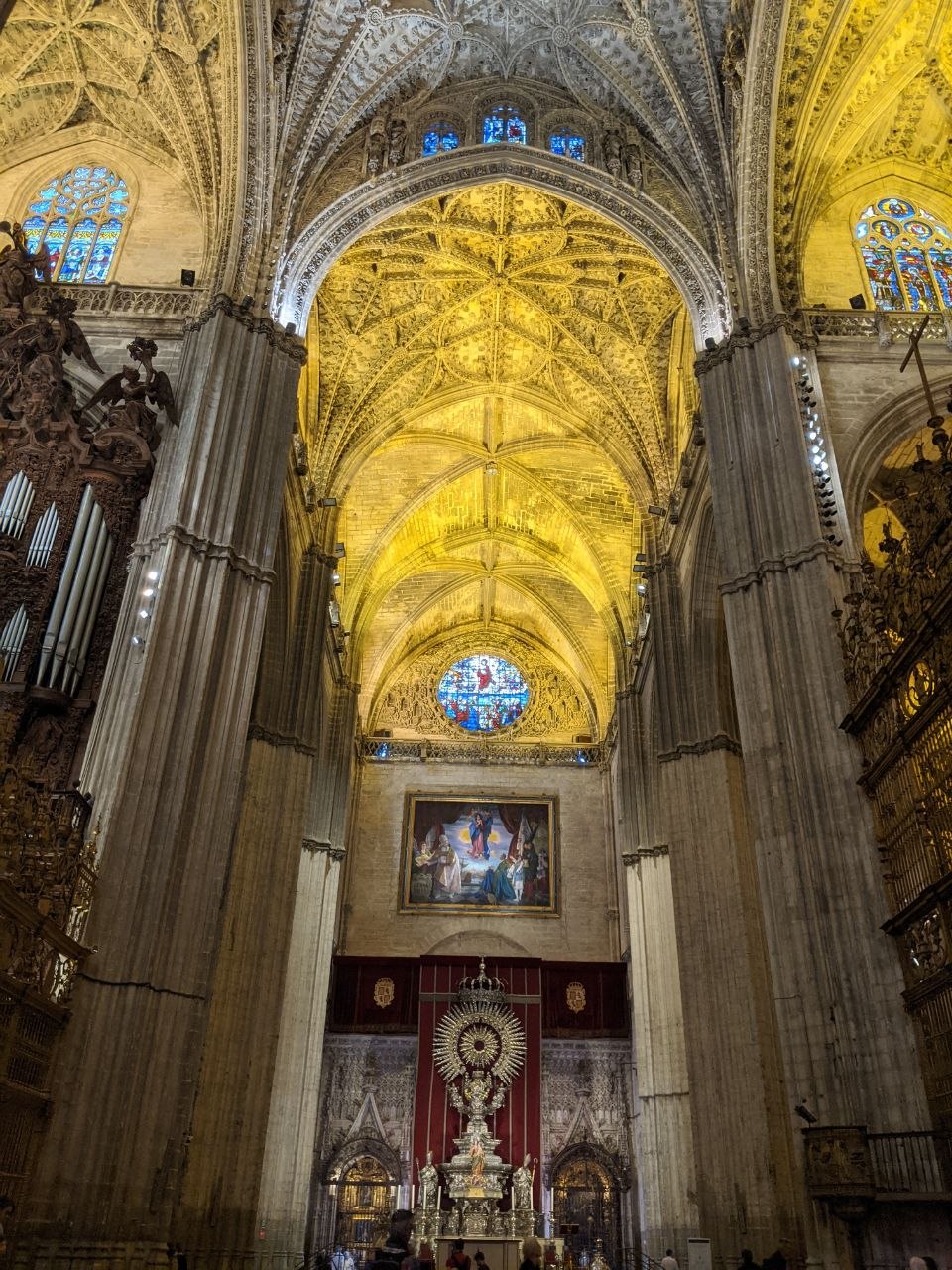
The Cathedral of Seville is the largest Gothic cathedral in the world by volume, and the third-largest church of any kind — surpassed only by St. Peter’s Basilica in Rome and St. Paul’s Cathedral in London. Construction began in 1401 on the site of the city’s former Great Mosque, of which only the Patio de los Naranjos (Orange Tree Courtyard) and the minaret — converted into the bell tower known as the Giralda — survive. The interior is one of the most awe-inspiring ecclesiastical spaces in Europe: five vast Gothic naves rising to ribbed vaulted ceilings illuminated by stained glass windows, the golden fan vaults of the crossing glowing in warm artificial light above the elaborately carved high altar. The tomb of Christopher Columbus, carried by four royal pallbearers representing the kingdoms of Castile, León, Aragon, and Navarre, stands in the south transept. The Giralda tower — originally a 12th-century Almohad minaret, its upper bell section added after the Reconquista — can be climbed via a series of ramps rather than stairs (designed to allow the muezzin to ride a horse to the top), offering panoramic views across the city rooftops to the Guadalquivir and the Plaza de España beyond.
The Barrio de Santa Cruz and the Churches of Seville
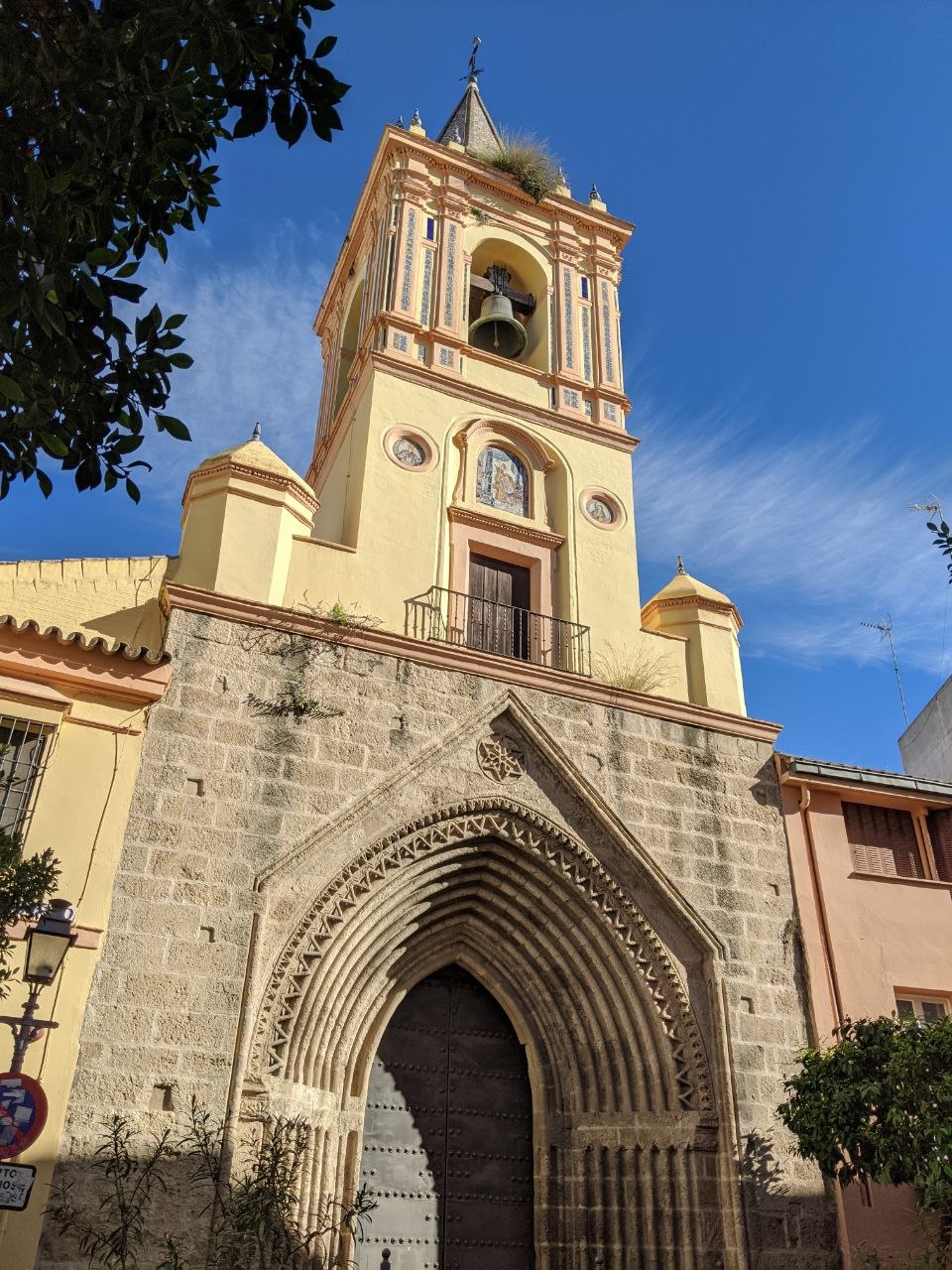
The Barrio de Santa Cruz — the former Jewish quarter of Seville — occupies the narrow lanes immediately east of the Cathedral and the Alcázar, a labyrinth of whitewashed walls, wrought-iron balconies, orange trees, and hidden plazas that form the most picturesque quarter of the old city. Scattered throughout the wider historic centre are dozens of churches that together constitute one of the richest concentrations of Baroque ecclesiastical architecture in Spain. Many were built in the 16th and 17th centuries on the sites of former mosques, inheriting their orientation and in some cases their structural fabric. A recurring feature of Seville’s church towers is the layered Baroque bell tower rising from a medieval stone base: cream or ochre plasterwork decorated with azulejo tile insets, arched belfry openings, and a small lantern or finial at the summit — a visual language repeated across the city’s skyline and visible above the rooftops of the old barrios.
Plaza de España
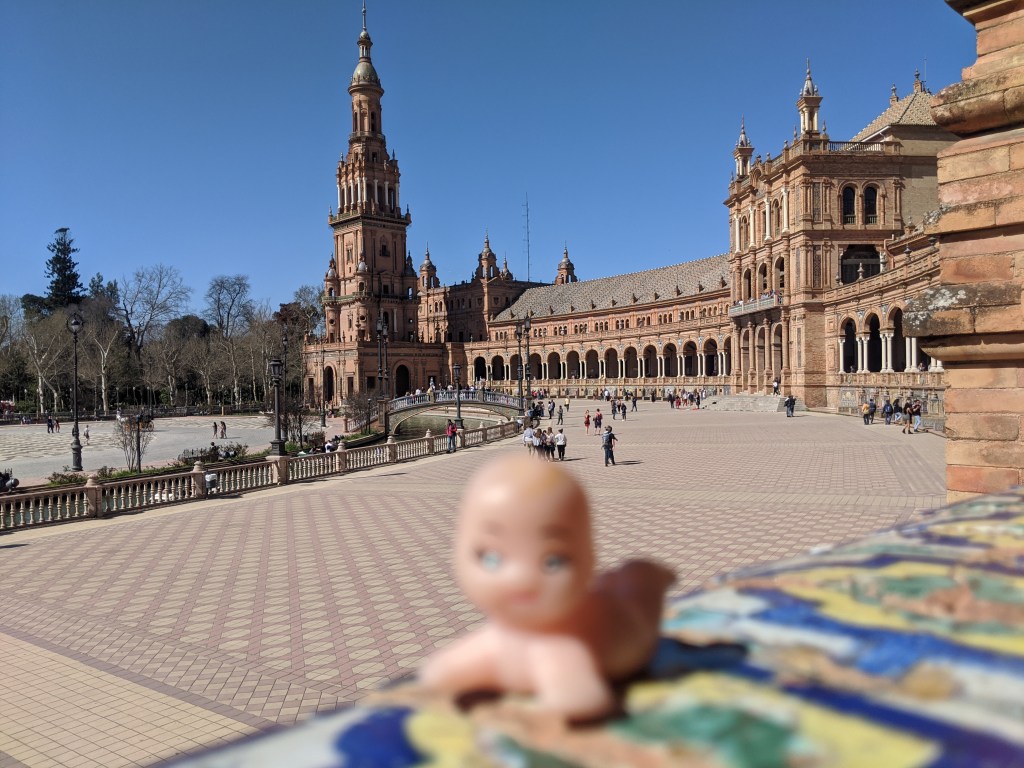
The Plaza de España is a vast semicircular civic monument built for the Ibero-American Exposition of 1929, designed by architect Aníbal González in a regionalist style combining Renaissance, Baroque, and Moorish elements. It occupies the northern end of the Parque de María Luisa — a large public park south of the city centre — and consists of a curving brick-and-tile building 170 metres in diameter, fronted by a moat crossed by four ornate bridges and lined at its base by 48 alcoves representing each of the provinces of Spain, each decorated with hand-painted azulejo tilework depicting a map and a historical scene from that province. A central fountain and tower anchor each end of the arc. The scale and decorative ambition of the Plaza de España are extraordinary — the combination of the curved colonnade, the water channel, the tilework, and the warm Andalusian light make it one of the most photographed public spaces in Spain.
Visiting Tips
Seville is served by Seville Airport (SVQ) and is also reachable by high-speed AVE train from Madrid (approximately 2.5 hours) and Córdoba (approximately 45 minutes). The historic centre is compact and best explored on foot or by bicycle — Seville has an extensive public bike-share network. The Real Alcázar and the Cathedral both require advance ticket bookings, particularly in spring and autumn when visitor numbers are highest. The Giralda climb is included with cathedral admission. Seville’s summers are extreme — July and August routinely exceed 40°C, and midday sightseeing is genuinely uncomfortable; the city comes alive again after 7pm. The most rewarding times to visit are March–May (including Semana Santa in Holy Week and the Feria de Abril two weeks later) and October–November, when temperatures are mild and the city is at its most atmospheric.
 Jumping Timezones
Leave a comment