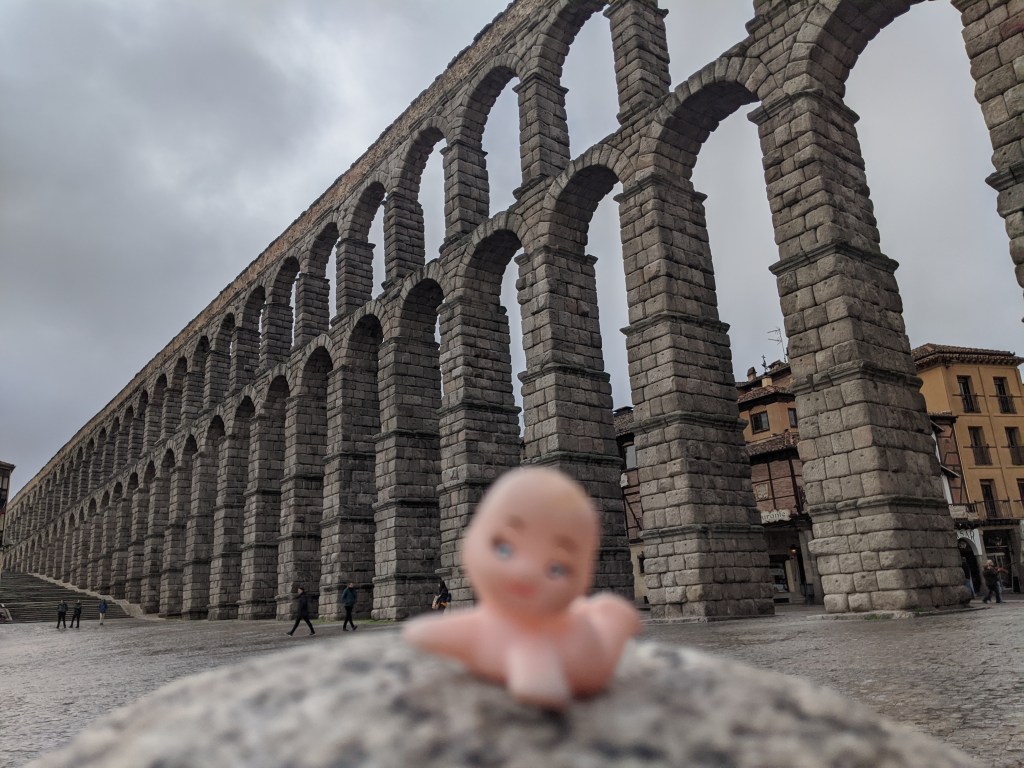
Segovia is a small historic city in the autonomous community of Castile and León in central Spain, located approximately 90 kilometres northwest of Madrid on the southern slopes of the Sierra de Guadarrama. With a population of around 50,000, it is among the most remarkably preserved medieval cities in the Iberian Peninsula, its old town occupying a narrow rocky promontory between two rivers — the Eresma and the Clamores. The city’s skyline is defined by three extraordinary monuments: a Roman aqueduct of the 1st or 2nd century AD, one of the best-preserved in the world; a Gothic cathedral completed in 1768, the last great Gothic cathedral built in Spain; and the Alcázar, a fairy-tale fortress palace at the western tip of the promontory whose distinctive silhouette is said to have inspired the design of Cinderella’s Castle at Disneyland. Segovia’s old town and aqueduct were designated a UNESCO World Heritage Site in 1985.
The Roman Aqueduct
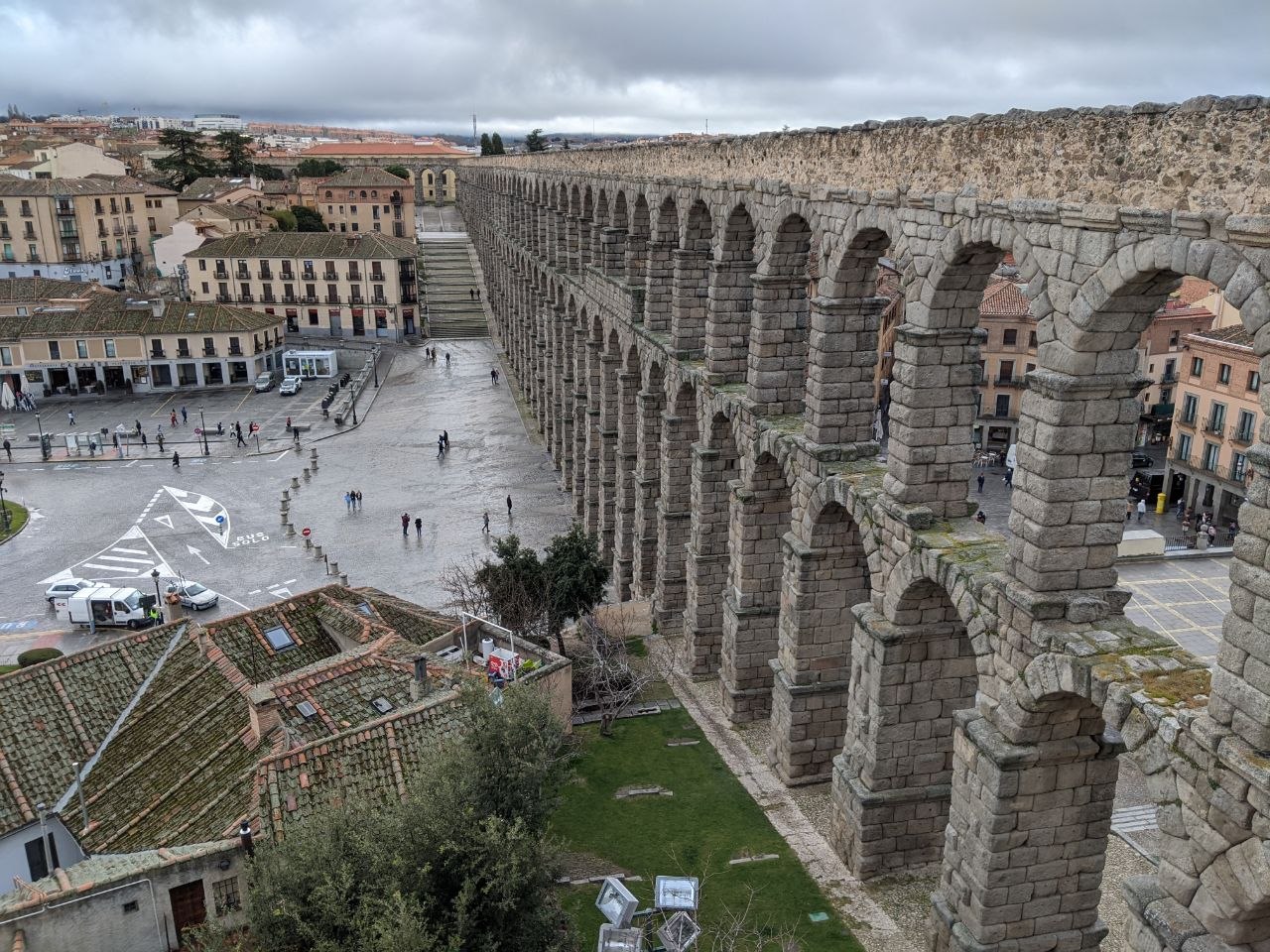
The Aqueduct of Segovia is one of the finest surviving examples of Roman civil engineering in the world, and the best-preserved Roman aqueduct still standing above ground. Built during the 1st or early 2nd century AD — most likely under the emperors Domitian or Trajan — it carried water from the Río Frío in the Sierra de Guadarrama some 15 kilometres to the city. The visible section of the aqueduct spans 728 metres and reaches a maximum height of 28.5 metres at its tallest point, where it crosses the Plaza del Azoguejo at the foot of the old town. The entire structure was built without mortar — approximately 20,000 granite blocks fitted together by precision and gravity alone, an engineering achievement that remained structurally sound for nearly two millennia. The aqueduct continued to carry water to the city until the late 19th century. Viewed from below at the Plaza del Azoguejo, the double tier of arches rises dramatically against the sky; viewed from above — from the old city walls or a nearby rooftop — the full length of the structure becomes apparent as it marches across the lower town toward the rock face.
The Alcázar
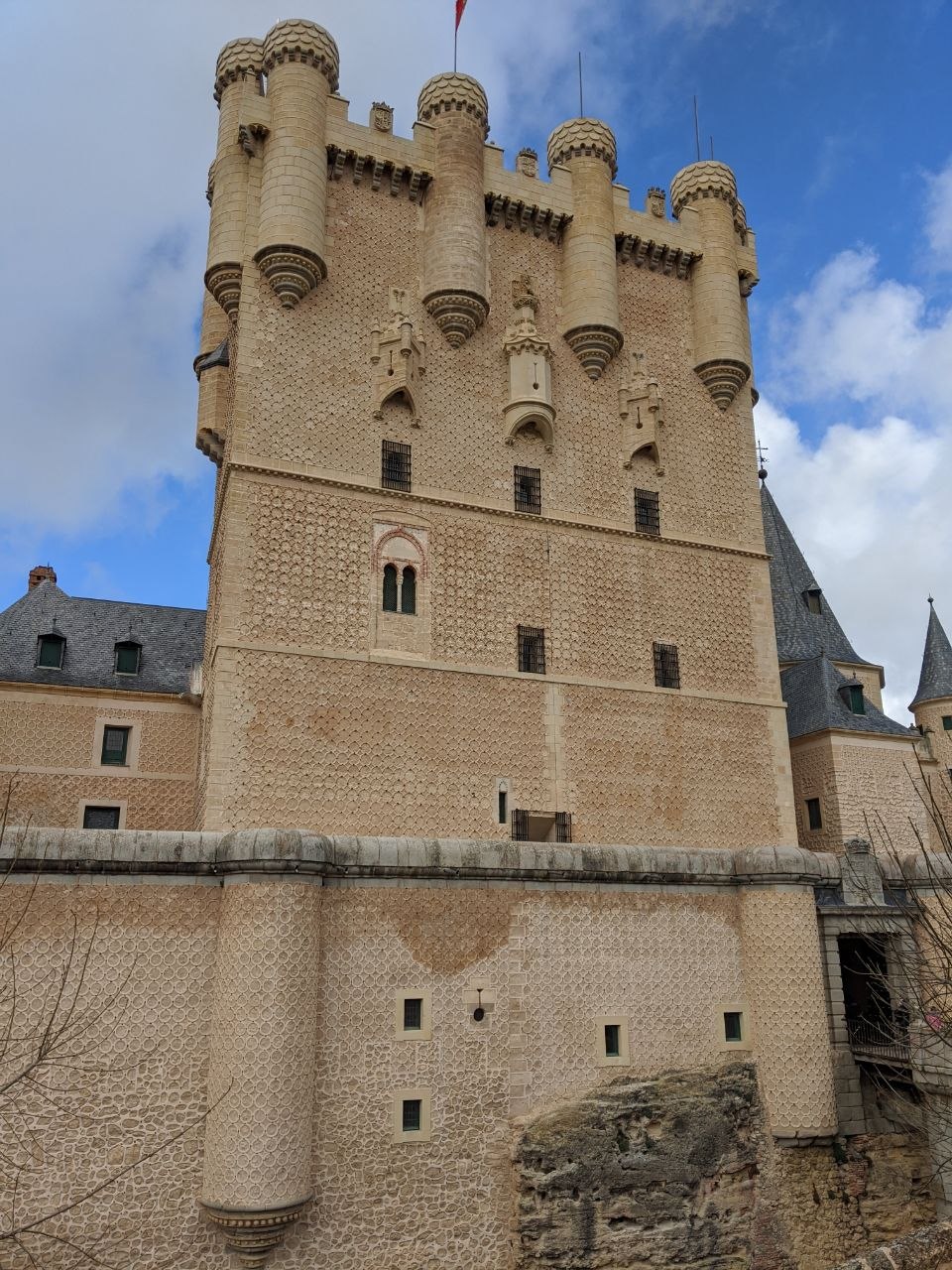
The Alcázar of Segovia sits on a sheer rocky promontory at the westernmost tip of the old town, where the Eresma and Clamores rivers converge below. Its origins are Moorish, with later construction beginning in earnest in the 12th century under Alfonso VIII of Castile. The fortress served throughout the medieval period as one of the most important royal residences in the Crown of Castile — Isabella I was proclaimed Queen of Castile here in 1474 — and later as a state prison and a royal artillery college. Much of the current appearance of the Alcázar dates from a major 19th-century restoration following a fire in 1862, which added the distinctive slate-roofed conical turrets that give the castle its storybook profile. The keep — the Torre de Juan II — rises above the main body of the fortress, its surface covered in a diamond-point stone pattern that gives the walls a distinctive texture visible from across the valley. The views from the Alcázar’s ramparts across the Eresma valley to the Vera Cruz church and the Sierra de Guadarrama beyond are among the finest in Castile.
Cochinillo Asado
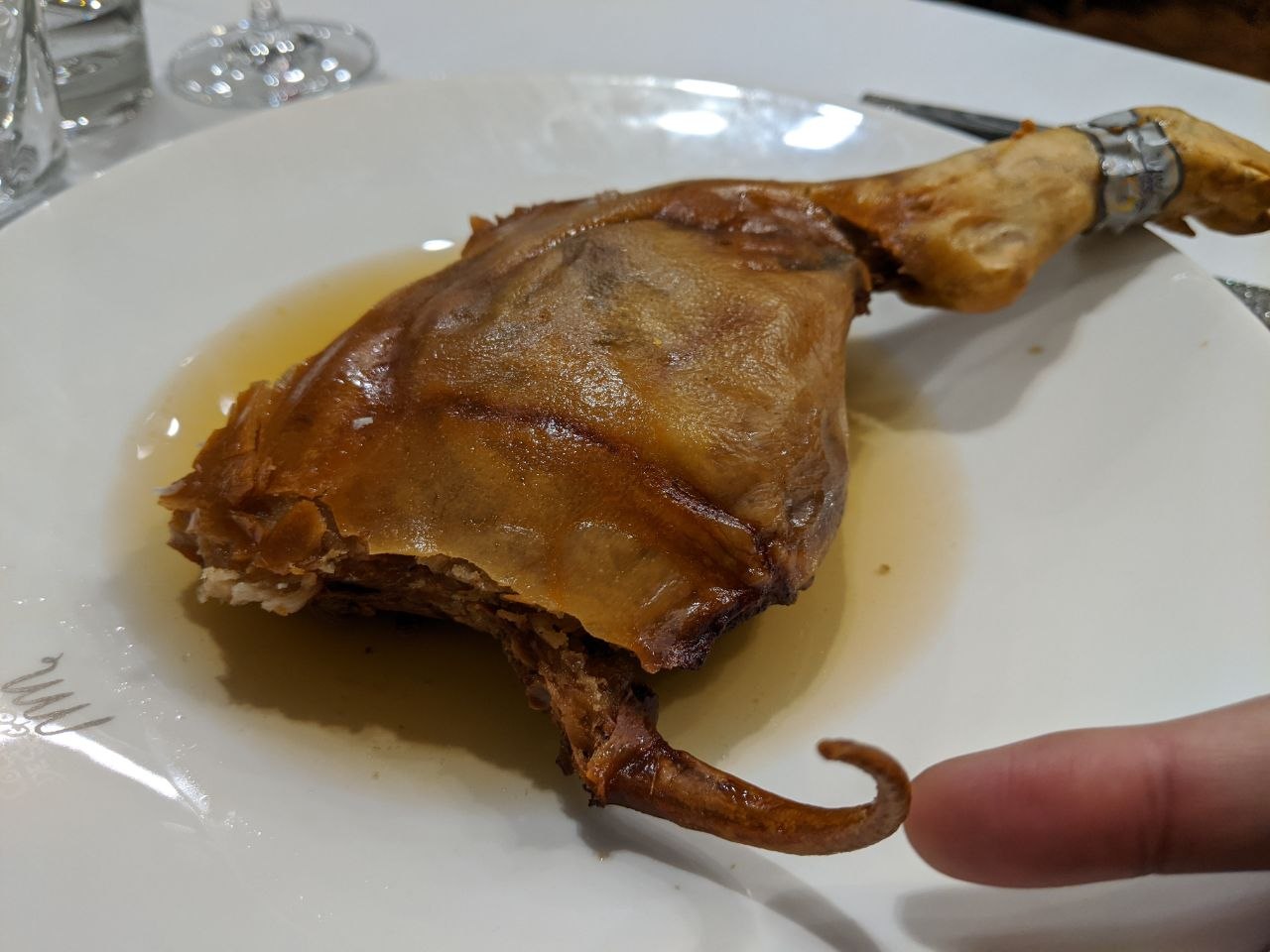
Segovia is one of the undisputed capitals of cochinillo asado — roast suckling pig — in Spain, a dish so embedded in local identity that it functions as a defining marker of Segovian cuisine and hospitality. Cochinillo is a piglet slaughtered at between two and three weeks of age, before it has eaten anything other than its mother’s milk. The result, after slow roasting in a wood-fired clay dish, is a remarkably thin, crackling skin — blistered and golden — over meat so tender it pulls apart at the touch. In Segovia’s most celebrated restaurants, the tradition is for the waiter to carve the cochinillo at the table using the edge of a dinner plate, demonstrating the tenderness of the meat, and then to smash the plate on the floor. The dish is served as a whole quarter — including the trotter — in a pool of its own cooking juices. The most famous establishment for cochinillo in Segovia is the Mesón de Cándido, operating since 1931 beside the aqueduct, though numerous restaurants throughout the old town serve the dish to a similar standard.
The Cathedral and Plaza Mayor
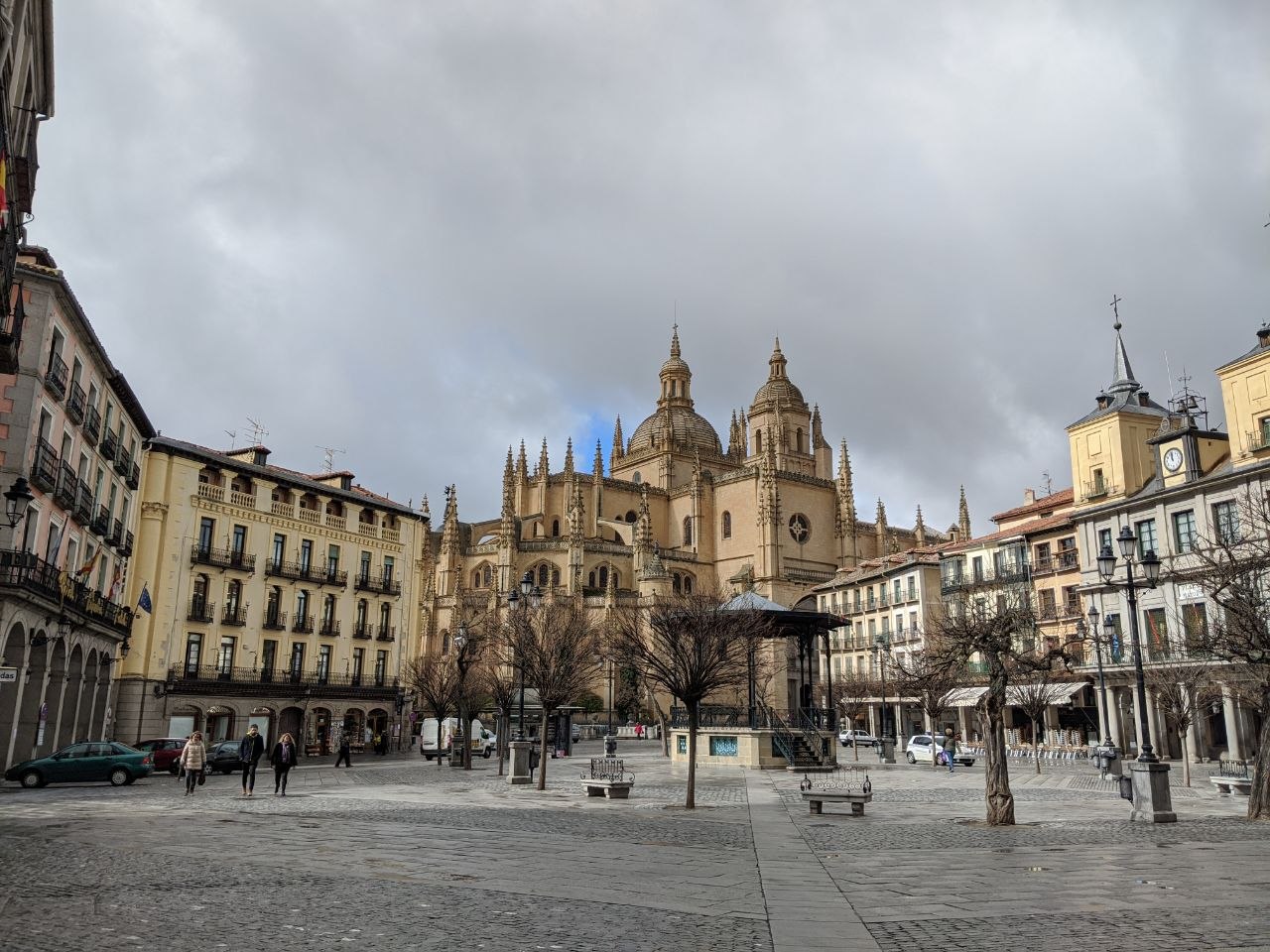
The Cathedral of Segovia, rising at the centre of the old town above the Plaza Mayor, is the last Gothic cathedral to be built in Spain, its construction beginning in 1525 and the main body completed in 1577, though work continued on various elements until 1768. Nicknamed “the Lady of Cathedrals” (La Dama de las Catedrales) for the elegance of its proportions, it is a late Gothic structure of golden limestone, its exterior richly decorated with pinnacles, flying buttresses, and carved ornament. The cathedral’s large central dome and two flanking towers are visible from across much of the city and define the skyline of the old town as seen from the valley below. The Plaza Mayor immediately in front of the cathedral is the social centre of Segovia — a broad cobbled square lined with arcaded buildings, café terraces, and the 16th-century town hall, its clock tower visible at the far end of the square.
Visiting Tips
Segovia is easily reachable from Madrid as a day trip: the high-speed AVE train from Madrid Chamartín takes approximately 27 minutes to Segovia-Guiomar station, from which a bus connects to the city centre. The old town is compact and walkable, though the streets are steep in places. The aqueduct is free to view at all hours; a viewing terrace at the level of the upper channel is accessible via the stairs beside the city wall. The Alcázar charges admission and is open daily — arrive early in peak season to avoid queues. Cochinillo is best eaten at lunch (the main meal of the day in Castile), and booking ahead at the more established restaurants is strongly recommended, particularly on weekends. Segovia is cold in winter and hot in summer; spring and autumn offer the most comfortable conditions for a visit.
 Jumping Timezones
Leave a comment